Sunday, December 09, 2012

Passages

Neil Monroe Jahnke
1942-2012
Neil Jahnke has died

Over the years I have interviewed many people. Few were as colourful as rancher, Neil Jahnke. In my book Just a Matter of Time a chapter is devoted to Neil.

October 17, 2004

Yesterday, the weather at home was mild as I set out on a journey to talk to cattlemen about how they’ve been affected by BSE and the closed border. I already have ten days worth of interviews done and wonder if the producers I’ve spoken to in Manitoba have a different perspective than those in the west.

This morning, I wake in Qu’Appelle, Saskatchewan, to find three inches of wet snow covering everything in the valley.

Neil and Marilyn Jahnke are expecting me in the early afternoon. I met Neil briefly once back in the summer of 1999 at the Canadian Cattlemen’s Association (CCA) semi-annual meeting in Penticton, B.C. I was working as the Communications Coordinator for the Manitoba Cattle Producers Association (MCPA), and knew Neil by reputation. The following year, he was elected vice-president of the CCA, which meant that in two years time, he’d likely become president of this umbrella organization that represents more than 90,000 producers across Canada.

There are people in the industry who are known for the things they say, what they do or the place they run. Neil Jahnke is a real cowboy who is known on all three accounts.

The windshield wipers beat frantically as the roar of the defroster muffles the radio announcer’s voice. I pull onto the highway and head south, surprised that I’m alone on the normally busy road.
Halfway up the hill leading out of the valley, I see that a tractor-trailer has jackknifed and lays sprawled across both lanes. I churn up snow, creeping past men standing alongside the road wearing ball caps and thick-soled felt-lined boots. They are looking at the wreck, deciding how to clean it up.
A long line of cars waits at the top of the hill while a police officer stands in the middle of the road directing traffic. An empty cattle liner has slid into the ditch, too, and had it been full of cattle, this would have been a catastrophe.

Jackknife. To double or bend from the middle. That’s exactly what has happened to the cattle industry. Everything came to a crashing halt because of one cow, and since then, cattlemen have been navigating a slippery slope. Waiting. Getting by as best they can in a storm of uncertainty that just won’t let up.

I spend a few tense hours on the Trans Canada Highway, crawling along snow-packed, polished pavement, hoping a nudge of wind won’t cause the car to shimmy into the other lane. I turn off at Chaplin, opting to take the backroads the rest of the way to Gouldtown.

There are few provinces in Canada that elicit more sarcastic, good-natured barbs than Saskatchewan: Easy to draw but hard to spell. This province is considered by most as one gigantic grain field interrupted only by the occasional, odd-named town. But that perception is untrue. The northern part of the province is rich with lakes and forest. The south central region is some of the best cattle land in the country, home to 1.33 million cows and nearly 22,000 cattle producers. This is the second largest beef-producing province.

There is something unspoiled about Saskatchewan that seems to rub off on its inhabitants. The people here have a self-sufficiency that can best be described as resilience from having grown up on the prairies. They are straightforward and helpful. Teenagers here look you straight in the eye.
I’m told that you can travel anywhere in the world and you’ll meet someone from Saskatchewan. Drive along the grid roads between the towns Eyebrow and Gouldtown, and you won’t meet a soul.
Taking my eyes off the desolate, gravel road long enough to flip through a book I’ve brought, I read that the town I’m looking for was named for an early pioneer named Mr. Gould. Not a particularly fascinating story.

Flipping back a few pages I locate Eyebrow. It was “named for Eyebrow Lake nine miles from the village. It is southeast of Elbow and the center of one of Saskatchewan’s better hunting and fishing districts.”5

I grew up in southern Ontario in an area that was considered rural. After moving to the ranch, I came to understand what the word rural means. There were people who would ask why I wanted to live in such a remote place. I’d answer with platitudes about the clean air and absence of crime, but I’ve since come to realize it lies deeper than that. Somewhere out here, buried deep in the chest of the prairies, is an explanation why so many pioneers came west, and in spite of tremendous hardships, never left.

The Jahnke place is further back from the main road than expected, and just when I think I’ve missed the turnoff, my eyes are drawn to a line of hydro poles soldiering on to the last place on the road.
Coming up over a rise, I see the Big Coulee Ranch nestled along the shore of the South Saskatchewan River. An inch of new snow softens the look of the frost-withered prairie wool. The river winds through the homestead, deep and blue as the back of a peacock’s head. The simple, ranch-style house is on this side; the barn and corrals sit on the other side, with a wooden bridge connecting the two. Settled in 1879 by railway surveyors, the Big Coulee was established with Texas cattle and has been in the Jahnke family since the early 1900s.

The car rattles over a corrugated Texas gate that separates the yard and pasture. Movement in the distance causes me to slow down to watch as a dozen horses crest the hill, galloping playfully, kicking up snow and nodding at one another. They continue toward me until their chests rub against the split rail fence that surrounds the yard. They follow it until they are close enough to the house that a whinny can be heard inside.

As I get out of the car, I wonder about the size of this place. Long ago I discovered that you don’t ask a cattleman how many cows he’s got. The old-fashioned fellows (and you can never be sure who they are) are insulted by the question. They say this is similar to asking a man how much money he makes, so I never do. I wait for him to offer, or go home not knowing.

I step from the cold wind into a porch filled with warmth and the smell of coffee brewing. The wall is lined with jackets, coveralls and a row of cowboy boots. A gravelly voice hollers to come on in.

Neil is sitting at the kitchen table. His nose and cheeks are wind slapped from two days working cattle. His hair, the colour of ripe grain on a frosty morning, sits flat against his forehead, pressed that way by his cowboy hat. He massages the full moustache that hangs like quotation marks at the corners of his mouth. He takes a sip of scotch, then invites me to sit down. He doesn’t remember meeting me and looks troubled by the fact.

Marilyn is at the opposite end of the table. She nods a polite hello, then finishes sorting through a bundle of cattle files. She has striking blue eyes, a quick smile and easy-to-keep dark hair. I notice a gentle rasp in her voice when she offers me a cup of coffee. I accept a sandwich while the three of us make small talk. Marilyn doesn’t seem to mind that most of my questions are for her husband.

The Jahnkes aren’t ready to settle into conversation yet because their grown children, Shane and Jennifer, are getting ready to leave. They came home for the weekend to help brand and process cattle. Neil is concerned about the weather so he checks the road report on the telephone’s speed dial, relaying back that the highway is clear to the west. The kids wave goodbye and tell their parents not to worry.

Neil had no idea in March of 2002 when he became President of the CCA that his outgoing year would be spent battling the worst crisis the industry has ever seen. He remembers where he was on May 20. He and Marilyn were on their way to the CCA head office in Calgary when CBC called his cell phone looking for comments.

“On the 18th I knew there was a suspected case,” he says, taking another sip of scotch. “I couldn’t tell anyone and didn’t sell any animals either. Let me tell you though, I’d be lying if I said it didn’t cross my mind.”

Within hours of the announcement, the U.S. border slammed shut to Canadian beef. With the industry here depending so heavily on exports, sixty percent to the U.S., the closed border meant that it took only a few days for beef and live cattle to begin backing up. Beef is a multi-billion-dollar industry in Canada—daily losses were estimated at $11 million.

In those first few months everyone was looking for the answer to one question: When will the border re-open?

In other countries that have reported cases of BSE, it has taken up to seven years for international borders to re-open. Producers, especially feedlot operators, grew frantic. Some of the pressure was relieved on August 8, 2003, when the United States Department of Agriculture (USDA) announced that they would allow in boxed beef—boneless cuts from animals under 30 months of age. This relieved some of the pressure off the packing plants, which were now in the envious position of having a market to ship to and an oversupply of fat animals waiting for slaughter.

For the Jahnkes, these months were remembered as a blur of activity. Neil spent countless hours on the phone, in meetings, and travelling between home, Ottawa, Calgary and the U.S.. Because Marilyn was President of the Saskatchewan Stock Growers Association, they were often running in opposite directions.

“We wore out at least two phones,” Marilyn laughs. “I’d be on one in here and he’d be standing in the porch talking on the other.”

Neil’s ice blue eyes soften as he watches her light a cigarette. He opens the pack and lights one, too, saying that 98 percent of the calls they received were from cattle producers pleased with their efforts.

“I had people saying that Saskatchewan producers were getting updates faster than anyone else because the president of the SSGA was sleeping with the president of the CCA,” he laughs.

Now each of them sits as Past Presidents of their respective organizations. Not as busy, but still involved.

I ask what motivated them to take on such high-profile positions. They chuckle together and Marilyn shrugs, saying that they did what they had to do.

Neil’s grandfather, father and uncles were all active with the provincial cattle organization. He attended his first meeting when he was 30.

“I always say that a person has to take his turn in the barrel so others can shoot at him,” he chuckles, smoking his cigarette down to the butt, then lighting another. He doesn’t hesitate to voice his opinion about how the situation was handled by government.

With the exception of the CFIA, Neil believes that the politicians, some bureaucrats and industry officials on both sides of the border have worked diligently in the best interest of this industry. He praised Federal Agriculture Minister Lyle Vanclief and Vanclief’s successor, Bob Speller. It was level-headed comments by politicians and industry officials in those first few days after the announcement that kept the hysteria down as they stressed this was not an epidemic but just one cow.

“I started calling him ‘one cow Vanclief,’” Neil laughs.

Canada is the only country in the world that has seen their beef consumption rise after reporting a case of BSE, thanks to fair reporting by the media and common sense on the part of consumers. Many communities held barbeques and “eat beef” rallies all across the country that helped boost consumer confidence and brought out the competitive nature of prairie folk.

“Every time Alberta had a barbeque, we had a bigger one,” Neil smiles, adding that 5,600 people came to a cookout in Moose Jaw. Saskatchewan stood behind its producers the same way they support their football team—unconditionally.

I ask what would have happened if consumers had stopped eating beef.

Neil inhales sharply, shakes his head, then takes a drag from his cigarette. He exhales slowly, blinks hard, then his eyes go to a faraway place.

“It would have been the biggest wreck you’ve ever seen.”

Afternoon wears into evening. I’m offered a glass of rhubarb wine made by local Hutterites. It’s both stronger and better tasting than I expect.

The actions of the CFIA are weighing down Neil’s thoughts. He recently received calls from a small, producer-owned plant that is having difficulty with them. He cites a doorway being an inch too narrow and an employee wash basin set three inches too close to a door as reasons the CFIA has refused to pass the plant’s inspection. Officials at the agency are deliberately making life difficult under the guise of food safety, not because they need to, but simply because they can.

“Another plant could have been killing 700 to 800 cows a day by now, but the CFIA is dragging its feet.” He calls this harassment of the industry at a time when fast tracking is needed.

I’ve heard countless explanations why it is taking so long for the border to re-open to live cattle. I ask Neil if he understands the reason for the delay.

Neil explains that the Office Internationale des Epizooties (OIE) administers plant and animal sanitation rules for health and safety considerations under the World Trade Organization (WTO) agreements, developing a risk assessment code for member countries. It has five categories of BSE risk, ranging from BSE free to high risk.

With the support of the United States and Mexico, Canada began immediately petitioning the OIE to re-write the rules to take into account updated, scientific understanding of the disease. Countries that have taken steps to manage the risk of BSE should not be penalized by having their borders closed because of one or two cases. The guidelines recently changed so that a country deemed minimal risk can have one positive BSE case for every one million adult animals in the previous 12 months, and retain low-risk status. Canada is waiting to be officially declared a minimal risk country.

He is quick to say that the Canadian government does not hesitate to enforce these same rules against others, closing borders immediately upon the discovery of BSE. Some call this an artificial trade barrier, while others say it is a necessary step if a country considered BSE free wants to keep the confidence of other BSE-free trading partners. Neil believes the Canadian government is as guilty as anybody when it comes to playing politics with BSE and border restrictions.

“We did it to other countries and now they are doing it to us,” he says.

The fact that the U.S. border did open in September 2003 to boxed beef from animals under 30 months of age is both a credit to the USDA and a compliment to our industry.

“Canada is the only country to ever export to a BSE-free country after only three months of trade stoppage,” he says, adding that ranchers saw prices in the fall as high as $1.30 a pound. No other producers in the world have been that lucky. He wants producers to understand that things could have been a lot worse.

I ask where the U.S. producer group Ranchers Cattlemen Action Legal Fund (R-CALF) fits into the puzzle.

Again, Neil blames the CFIA. He explains that strict regulations imposed by the government make it difficult for American producers to do business here. There are two cattle diseases in the U.S.—Aniplasmosis and Blue Tongue—that do not exist in Canada. These diseases are transmitted by insects which cannot survive our harsh winters. Blue Tongue is the more serious of the two because it is considered untreatable and sometimes fatal. Aniplasmosis can be treated with antibiotics and animals usually recover. Neither disease is contagious or a threat to human health, but Canadian regulations mean American livestock accepted into Canada have to first go through rigorous testing and quarantine before they can touch Canadian soil. The CCA has been fighting against these restrictions for years. They want the diseases placed on the annual notifiable list just as they are in the U.S., which allows the industry to take responsibility for managing the risk. Neil believes that if it wasn’t for the rigid hand of the CFIA, R-CALF likely wouldn’t exist.

He says that for 17 years, cattlemen in the northern states have been watching thousands of trucks filled with our cattle passing through their states, and for the last 15 of those years knew there was no scientific basis for the restrictions toward them. Neil calls this Canada’s lesson to start basing decisions on science, too.

“They wanted to trade up here but the costs made it near impossible. So, they got mad and then got organized and now we have R-CALF.”

Suspecting R-CALF would find reasons to petition to keep the border closed, Neil shared this fear with the federal agriculture ministers and anyone else in government who’d listen. Again he recommended the relaxation of these import rules and even spoke to Brian Evans, one of the top men at the CFIA.

“I had him cornered on a plane, so he couldn’t get away from me,” he laughs. “But he still refused to move on it, even after having explained it to him in plain English. Unbelievable, really. I’d rather deal with Revenue Canada than the CFIA.”

Finally, with mounting pressure due to the prolonged border closure, the CFIA was forced to address the issue and relaxed the restrictions earlier this year, but the damage was already done.

While on the topic of the CFIA, I ask his opinion about how the McCreas were treated.
Neil scowls and shakes his head.

He explains that the CFIA came to him once, concerned that Mel wasn’t going to give up the animals. Neil phoned Mel and they had a long chat and, of course, Mel understood; he was just angry and frustrated. Afterward, Neil phoned the CFIA and told them that there would be no problems at the McCreas.

Neil looks past me, focusing on the wall over my shoulder, rubbing his moustache as he recalls that evening’s news broadcast.

Apparently, the CFIA arrived at the McCrea house shortly after they spoke, flanked by RCMP officers, with the media and film crew close behind. Neil hated watching Mel’s concern for his cattle being mocked.

“I wouldn’t be surprised if Mel never spoke to me again,” he says. “After the fact, it looked like I was conspiring with those bastards against him, which I sure in hell was not.”

As we settle into our chairs after supper, I ask if there is a business more complex than the cattle industry.

Marilyn raises her eyebrows as she ponders the question. Neil tilts his head slightly and thinks. It appears that nobody has ever asked this before. We debate the complexities of lumber and the auto industry, concluding that dealing in live animals adds a complexity otherwise missing from most big business. In Canada, the beef industry was worth $30 billion to the economy in 2002. Unlike chickens, eggs, hogs and milk, cattle production is not managed by a marketing board. In fact, those two words will quickly raise the ire of a true cattleman.

I need to understand why.

“We regulate ourselves,” he replies, explaining that supply management of beef would be the ruination of the industry, because orderly marketing is considered subsidization by trading partners, and huge duties would be imposed on our meat, making Canadian beef and live cattle less competitive. For supply management to work, quotas would have to be established, and that would shrink the industry to half the size in order to eliminate the reliance on exports. Many producers would be forced out of business, resulting in a waste of the natural prairie grasslands that are good for little else. Neil calls proponents of the idea selfish and stupid.

We debate this and other issues long into the night. Marilyn shows me the guest bedroom and it isn’t long before I’m tucked under a snug, homemade quilt, listening to the wind outside whistling through the coulee.

The next morning, I wake to the relentless wind and the glow of a sun halfway up. Its reflection has cast everything outside in a silver blue sheen. I emerge from the room to the quiet sounds of morning that begin in the kitchen. A light glows golden and the smell of fresh coffee adds to the cozy feeling of a warm house on a winter morning.

Neil stifles a cough to keep it from echoing throughout the still house. He is standing gazing out the window, enjoying his first smoke of the day.

“Some men have girlfriends or cabins at the lake,” he says, taking a sip of coffee. “That’s my vice right there. My horses.”

I peer out the window to see the animals looking back in at him. Knowing Neil a bit better today, I suspect that these are expensive purebreds. The stormy northwest wind whips pellets of freezing rain against the window. Two more inches of snow have fallen and it is starting to blow.

We talk about the prairies and why he lives here. He admits that the raw beauty of the place is something he’s gotten used to, but it isn’t something he ever takes for granted.

“Sure glad we did those cattle yesterday,” he says. Most of his life he’s made decisions based on gut feeling, and now confirms that once again his instincts were right.

We sit for awhile in silence, then I tell him how much I like their coffee. He brightens, saying that there is a natural flowing spring that supplies drinking water to the house.

Marilyn joins us and Neil offers to make breakfast. Once we’ve had our fill of coffee, we decide to take a tour of the ranch. As we climb into his diesel pick-up, Neil admits that BSE is not the first hardship that Canadian cattlemen have faced.

He tells me that in 1951 calves were bringing 33 cents a pound, and a year later there was a Foot and Mouth outbreak that caused prices to drop to 11 cents. It took until 1965 before they saw prices around 30 cents again.

Ploughing along prairie trails filled with snow, he shifts into four-wheel drive to climb a steep incline. I hold on as the truck bounces along the rough pasture.

“I went to the banker in 1972 when we wanted to buy the ranch and he told me that we’d never make it,” he says, slowing the truck to a stop. The trail ahead continues for another truck length, then the earth falls away. “This here is likely the prettiest spot on the ranch,” he says, nodding for me to go out and take a look. As soon as I’m out of the lee of the truck, the wind grabs ahold of me and whips ice pellets against my face. I go only as far out as necessary to glance over the edge. The water churns a few hundred feet below as the snow tries frantically to fill up the valley. I imagine how beautiful this spot would be in the summer.

I climb back into the truck and as Neil turns around and begins following our trail back toward the house, he finishes his story, saying that in the fall of 1973 he was offered 67 cents a pound for his steer calves and 75 cents for the light calves. He figured that price was too low, so he held on to them and wintered them. In February he was offered 38 cents, so he took it and ran, but there were lots of guys who wouldn’t. By May, calves were selling for 25 cents a pound.

 “We had a couple of really good years, but then that wreck happened. We just dug in our heels and cut back. We didn’t hire any help and did all the work ourselves. Marilyn went five years without a new dress or a new pair of shoes.”

Neil takes me to the other side of the river where he suspects the cows might be. Sure enough, we find them sheltering in a bluff of trees along a stream that feeds into the river. We sit and watch the cows for a few minutes, beautiful black animals that stand quietly watching us back.

He explains he’s expanded numerous times since buying the place from his uncle, and now runs 1,200 cows, mainly Black Angus. A good portion are purebreds. Since he calves on the grass, he uses easy calving, longhorn bulls on the heifers. He claims to have a 95% calving rate and says that “my cows work for me, I don’t work for them.”

On the way back, I point to a set of four old wooden wagon wheels in the field near the barn. I’ve been looking for three years for a set to use as ornamentation in the large flower garden along the south side of my house. He smiles at the frivolity of this, but drives over so I can take a look. Once again, I step out into the storm, but am thrilled to find good oak wheels set snug in the rim, and about the size I’m looking for.

I ask if he’ll sell them to me as I climb back in, breathless from fighting the snow and wind.
He laughs, telling me I can have them. All I have to do is come back to pick them up. I can hardly believe my luck!

“If I had a dollar for every time I’ve given that set of wheels away. . .” he chuckles as he swings the truck back onto the trail.

Neil asks where I’m heading as I load my bag and camera into the car. He’s standing in the doorway of the garage, with his hands in his jean pockets, stocking feet on the cold cement floor.
I tell him there are people I’d like to see in Swift Current.

“Well, if you get the chance, go and stay at the old Commercial Hotel in Maple Creek. You can’t do a story about the cattle industry without going to old Cow Town,” he says.
I nod that I will, then wave a quick goodbye as I pull the car door shut and turn up the heat before backing away.

I drive for awhile along the unmarked roads, distracted by thoughts about cattlemen surviving hard times without asking for help. They wear their independence like a badge of honour and if BSE has done anything, it’s hurt pride as much as bank accounts.

Suddenly, the sights along the road look unfamiliar. I rifle through my bag and pull out a compass; that helps me get back on track before I drain the tank driving in the wrong direction. I fill up in Herbert, then pull onto the Trans-Canada Highway west.

The clerk at the motel in Swift Current gives me a quiet room along the back of the lot and I spend the rest of the afternoon writing. I make a few calls that evening.

A friend told me more than once that if I go to Saskatchewan, I have to call Bob Switzer. I flip through my book to the page with Switzer’s phone number and pick up the phone. A gruff voice on the other end agrees to meet with me the next morning, but says he only has a half hour to spare because he’s going to a cattle sale in Maple Creek afterward. I can’t believe my luck again! We agree to meet there instead and I hang up the phone, thankful for those moments when things seem to fall neatly into place.

NOTE: After the book was released, I sent a copy to Neil and Marilyn. He later called to say that those wagon wheels were still sitting in the field waiting for me. All I had to do was come with the truck and pick them up. I promised that I would, but never made it back. 
___________________________________________________________ 

Tuesday, October 30, 2012

Reflections

Hallowe'en 1988

The clown from hell

Unlike my mother, I was not very good at making Hallowe'en costumes. So it came as a relief the year that my sister-in-law Sharon gave me a costume that Becky had wore. It fit Laurie perfectly and he didn't seem to care either way, so it was decided quite early that Laurie would be a clown for hallowe'en. That is until he spotted a mask in the Arborg Pharmacy.

It was seldom that Laurie demanded that we buy something so I was stunned. In fact, that was the only time I ever remember him refusing to leave a store without getting his way. So I bought him the mask and he ran around the house wearing it every day leading up to Hallowe'en. What I didn't know at the time is that this mask would create a lasting memory, one of those treasured moments in time that become more precious as the years pass.

Since Laurie only cared about wearing the mask there seemed little point in putting much effort into the rest of the costume. It was always cold Hallowe'en night so he'd have to wear his jacket anyway and the clown costume fit over his coat. So that is what he wore. I called him the "clown from hell." We drove throughout the community, stopping at each neighbour's house and Laurie, thinking that nobody recognized him, growled and roared while knarling his fingers and everyone laughed thinking this was very cute. Everyone except for Keith Halldorson.

When we arrived at Halldorson's house, Keith was frying something on the stove so the kitchen was filled with smoke. It is the only time I have ever seen Keith cook, so that in itself was memorable. I have no idea where Dorothy was . . . it was seldom that they weren't home together, and it is hard to imagine that whatever he was frying became edible in the end. But at any rate, as we stepped into the kitchen, Laurie jumped out from behind me and let out his best growl.

Keith took one look and screamed. Really loud. He threw down the spatula and ran right past us, out the side door, and onto the grass. Laurie took off running after him and I followed to watch as Keith ran around in barefeet and track pants, screaming like a girl, waving his arms frantically as he tried to get away with Laurie knashing teeth right behind him. It was dark, cold and after a few moments, the intensity of it all started to get a bit frightening for Laurie. He pulled off the mask and in a quivering voice said, "It's okay Keith, it's just me! Laurie!"

To fully appreciate this story, you had to know Keith Halldorson.
I'm sure glad that I did.
___________________________________________________________

Under the Dumb Plum Tree

Mom, Paul & Darlene's Dana

October's Leaves

by Jaime Kaufhold
(October 1991)

October is a truly beautiful month. It signals the end of summer and with it comes the most spectacular array of colour. The trees that shaded us during those hot summer days have dropped their leaves, creating a blanket across the ground. My poor old plum tree is naked now.

I just came in from raking leaves, thinking about what to write this month and realized that there is a lot to talk about in October. Of course we could mention how everyone is getting ready for winter - it is the perfect time to winterize cottages, haul out the boat and do any repairs that are necessary. Farmers are thinking about next year's crops, ploughing and preparing their fields and the cattle must be sheltered. And of course, there is always Thanksgiving to plan around.

What a memorable weekend that always was. An extra day off school for the kids who'd bring large paper turkeys home Friday afternoon, that we'd hang on the door. I'd prepare a big meal with all the traditional fare and sometimes friends would join us. By the time Thanksgiving rolled around, the fall foods we'd eat were a much needed change from the barbeque season.

But of course all the children could think about was Hallowe'en. For weeks they would mull over  what they were going to "be" and prepare for the school costume party. They always hoped to have the best and most unusual costumes. Back then, most costumes were home made and I could be pretty inventive. One time we made Mark into a robot by spray painting different sized boxes silver, creating a body, arms, legs and head. And I remember sewing old buttons and bows of different sizes and colours all over Nancy's shirt and pants. One year we turned Karen into a bag lady by sewing all sorts of household items and junk onto an old workshirt and pair of pants. My kids never went to school dressed as a ghost, princess or superman. I wasn't exactly sure what they were, but it was memorable.

When Hallowe'en night finally arrived, off they went to fill their bags with goodies. I was left home to some tricking of my own and usually it was the poor dog who suffered. It was hilarious to watch our big, fat black lab, Minnie, run terrified away from the door each time she saw a goblin arrive. Then, when the loot was brought home and sorted on the rug in the living room, I kept a close eye on who had what. When the kids fell asleep, I'd sneak into their rooms and raid their goodie bags for some of the treats I liked best. They never noticed, or if they did, never mentioned it.

Now it's time to go back outside to rake more leaves. It is windy so I'm hoping the pile will blow next door, but I guess that means I'll end up with the neighbour's leaves who lives upwind of here. Oh well. The grandchildren will come for a visit and the piles provide hours of fun.

After Hallowe'en I usually have a nice, large pumpkin to dispose of. Guess what I make?

Pumpkin Pie

2 cups pumpkin
3/4 cup light brown sugar, packed
3 tablespoons fancy molasses
1 teaspoon cinnamon
1/4 teaspoon ground nutmeg
1/8 teaspoon ground cloves
1/2 teaspoon fine salt
3 large eggs
1 1/3 cups whipping cream
3 tablespoons brandy or orange liqueur

Preheat oven to 400 degrees.
For filling, cook your pumpkin until soft, then let it drain in a mesh colander until fairly dry. Or you can use canned pumpkin from the store. Whisk it in a bowl with all the ingredients then pour into an uncooked, 9” pie shell.

Bake for 10 minutes, then lower temperature to 350 degrees and bake for 20 to 30 minutes, or until filling puffs just a little around edges. Test with a fork by poking the middle. If you like your pie soft, remove when it still jiggles a bit in the center. But if you're like me and prefer it dense, cook until the fork comes out nearly clean. Allow to cool to room temperature, then put in the fridge.

Whipped Cream
1 cup whipping cream
2 teaspoons sugar
1/4 teaspoon cinnamon
pinch nutmeg

Whip it up, spread it all over the pie right before serving and enjoy! If you think you might have leftovers (we never did), don't spread the whipped cream over top, just add spoonfuls to the individual pieces. You'll probably need to re-whip the leftover cream the next day.
___________________________________________________________ 

Tuesday, October 09, 2012

Under the Dumb Plum Tree

Thanksgiving weekend I made Mom's Chili Sauce

Chili Sauce

by Jaime Kaufhold
(September 17, 1991)

September has always been a lovely month for me. This year's weather has been great and it's time to harvest the bountiful crop of tomatoes, onions and peppers from my garden. Summer just wouldn't be complete if I didn't do some canning. I made chili sauce again - oh how I love the aroma of chili sauce simmering on the stove. There is something about canning which demands it be done on a fall day with the windows open so everyone can smell the wonderful infectious aroma.

Every year I say it will be the last time I make chili sauce because we don't eat as much as we used to, but year after year I get many requests for the piquant sauce, so back to the hot kitchen I went last week.

My eldest daughter came for her annual visit and we had a lovely time together. This time, she persuaded me to purchase a word processor, saying that it will be easier for me to write and edit my column. The manual I received with the machine is approximately two inches thick and I am still on page 14. The computer age is here and whether I can figure it out and benefit from it will remain to be seen.

Having Karen here for a week was like stepping back in time. The children all had to visit with one another so of course they all said, "Let's go to Mom's!" I was prepared for them, after filling the grocery cart and making a family meal. Our visit went well and it was just like the good old days as I listened to their happy chatter. It makes me realize how peaceful and quiet my life has become. Now that they are back at their respective homes, I feel like poor old Mother Hubbard.

The week with Karen went by quickly and as she prepared to leave, I found myself asking the same questions as always: "Are you packed? Have you forgotten anything?" The reply was, "of course, Mom, don't worry so much." Pacing, I watched the clock. I have learned from experience that if we don't leave soon, she may miss the plane. I remember well the time my husband and I spent a lovely vacation in Europe visiting with relatives. We were casually saying our good-byes at the Frankfurt airport. I heard the word "Canada," faintly announced and as we ran towards the departure gate, I caught a glimpse of the tail end of a plane with a red maple leaf, backing away. Somehow we managed to catch the flight and found our seats amongst fellow passengers, many laughing at the sight of us. Others were angry for the delay and it was quite embarrassing. So that explains my paranoia about missing the plane.

The bathroom door remained closed and I could hear the hair dryer going at full speed. I wondered how someone with such short hair could take so long to fix it. I glanced at my watch again and after what seemed like an eternity, she emerged lovely as ever. Soon we were on our way and arrived at the airport with plenty of time. We said our good-byes, hugged and kissed and as I watched her go through security, looked forward to the phone call that would come later, as she opened her suitcase to find two carefully wrapped jars of chili sauce that I'd tucked inside. Chili sauce is Karen's favourite and she always serves it when she cooks roast beef, which is often considering they have a cattle farm. She is a busy mother, business owner and writer who doesn't have time to do canning herself.

Maybe someday she will and I hope if she does, she'll follow my recipe.

Mom's Chili Sauce

12 cups ripe tomatoes
4 cups tomato paste or tomato puree
2 large onions
4 green peppers
4 stalks celery
1 cup brown sugar
1 1/4 cup vinegar
1/4 cup lemon juice
4 cloves garlic, minced
1 tbsp mustard seed
1 1/2 tbsp salt
1/2 tsp cayenne pepper
1 1/4 tsp cloves
3/4 tsp cinnamon
1 tsp allspice
3/4 tsp nutmeg

Wash, peel and cut tomatoes, onions, peppers, celery. Place everything except the tomato paste and lemon juice together in a pot.

Heat until bubbly, then reduce temperature to low and cook for approx. 5 hours, stirring frequently. Add tomato paste and lemon juice. At this point, the sauce should be quite thick so watch it closely as you continue cooking to desired thickness, as it will scorch easily. If you don't have time to finish the process in one day, refrigerate the sauce for a day or two and then warm up in a microwave right before ladling into jars.

This recipe fills 16, 8oz. jars. 
___________________________________________________________ 

Tuesday, September 04, 2012

Under the Dumb Plum Tree

Laurie & I at my former school, two years before Mom wrote this column
Back to School
by Jaime Kaufhold
(August 1991)

The children are heading back to school today and I can't help but recall some of our "back to school" shopping expeditions. Fifteen years ago it was no laughing matter, but now I have to chuckle.

Two days before school started, off we would go, me and my four children with their lists. We'd pull into the mall parking lot in front of the Woolco department store. Inside, school supplies would be piled high and a landslide was usually created as the kids dug through, looking for the most desirable brand names. Did you know that there were at least seven brands of pencil crayons, but that only one brand, Laurentian, was acceptable? My13 year-old daughter Karen (who is still fussy) said that the lead on anything but that brand was too hard and left scratch marks on the paper. Everything had to be just so, and the brand names were always the most expensive.

Buying back to school clothes was by far the most frustrating part of the experience. My son Mark was satisfied with anything new, since he grew at such an unbelievable rate that his clothes always looked too small (flood pants they were called). So long as he could dress in one colour from head to toe he was happy. So that meant brown shirt, brown pants, brown socks - repeat in blue and black and he was ready for class.

The girls on the other hand were impossible, especially as they got older. They weren't interested in anything "no name," or if it wasn't in their favourite colour. Karen had to have Levi's and Nancy was tired of me matching her with her younger sister and preferred to have whatever Karen was getting just in a smaller size. Darlene wasn't too fussy but it wasn't always easy finding exactly what she wanted in her size. Since I was on a limited budget this was always a very difficult shopping trip and when I'd try to explain to them that we didn't have much money, they would usually reply, "just write a cheque."

Last year's lunch pails were long gone, either lost or destroyed. I preferred the durability of metal but they didn't have cartoon characters on the front, so I reluctantly agreed, knowing that the plastic thermos that came with the plastic pails would be broken the first week. The two older ones preferred paper bags, and instead of traditional waxed paper, all wanted to have their sandwiches inside the new ziplock sandwich bags, except Karen who wanted a plastic container for hers, so I'd go through the motions and most years, get what they wanted, knowing that the lunch pails would get kicked around the school yard, we'd run out of zip lock bags, and the little plastic container would be found when the teacher forced Karen to clean out her locker at Christmas break. Something would be inevitably be growing inside, and everyone, myself included, would be too chicken to open it up and clean it out, so the container would end up in the garbage.

Wanting to be a popular mother, I'd stock up on a few goodies for their lunches. I'd buy sandwich meat, cheese slices and a few pre-packaged treats, which were all expensive, not very healthy and didn't stretch very far, but the kids loved it. Within a week, I'd be back to peanut butter and jam sandwiches wrapped in waxed paper, with home made cookies, butter tarts, cupcakes or fudge. Later I found out that the kids traded or sold their lunches because the kids who got the pre-packaged foods all the time, wanted the home baking that my kids were sick of! Mark tells me now that he could get almost anything in exchange for my date-filled oatmeal cookies.

Today it must be much more confusing shopping for school because there are so many more choices. Stores are filled with items that are new and improved, caffeine free, sugar free, low this and reduced that. The only cereals I recognize are Corn Flakes, Rice Krispies, Shreddies, Cheerios and Shredded Wheat - the rest are all sugar free or all sugar, high fibre, cholesterol free and fat reduced. What I can't understand though is with all these products being "light, low and free" why my buggy is so heavy and costs 30% more? Packing lunches in the 90s must be a nightmare.

To avoid the stress of shopping at the last minute, one year I decided to do my shopping in mid- August. What a mistake! By then the treats were gone, the school supplies were all used up or lost and the girls were so anxious to wear their new fall clothes, that despite my warnings, wore them the first day of school even though it was incredibly hot that year. They returned home, pink faced and sweating, wearing their new corduroy pants, turtle neck sweaters and fall jackets.

Despite all of this, the first day of school remains an exciting time for everyone. I remember watching as my three children stood at the end of the driveway waiting for the bus, and the following year, Darlene joined them as she entered kindergarten. However, when she arrived home, she was the only one who didn't want to go back after her first day. Perplexed, I asked why. She told me that she felt sorry for me being home alone, so we went to the SPCA the next day and got a little black dog we named Foxy to keep me company. Satisfied that I wouldn't be lonely without her, Darlene went to school with the others the next day, and like the others, went on to graduate.

Today, out my window I can see the neighbour girl waiting patiently to join her friends and classmates. She turns and waves to her mother as the bus drives up and stops, she boards the bus then it slowly pulls away. I can see my neighbour smiling and waving, and remember how she feels as if it were yesterday.

Now, I'll pour myself a cup of coffee and along with my dog, will relax for awhile under my dumb plum tree.
___________________________________________________________

Thursday, August 02, 2012

Under the Dumb Plum Tree

Mom on one of our camping trips in the 1970s.
Camping
by Jaime Kaufhold
(July 1991)

School has been out for a month now and the children are happy but soon will complain they have nothing to do and will be anxious to get back to class. Between now and then, many of them will go on vacation.

My daughter Nancy called this morning to ask if they could borrow some of our camping equipment. It is old, but like new since it hasn't been used too often. I'd better get out to the garage and hunt around for it all, but first I'll finish my coffee under the cool shade of my tree.

Camping.
I remember well our family camping trips, usually made on the long weekends in July and August. Although it has been many years since I lit a campfire, it feels like yesterday.

For three days prior to departure, I got ready, but still always managed to forget something. Amazingly, our Pinto station wagon carried my husband and myself, our four children, two of their friends, two dogs (an overly friendly lab and a beagle that bit) and we pulled a small utility trailer behind.

This was the thing to do in the 70s. Call it what you like - camping, getting back to nature, getting away from it all, relaxation, roughing it. Once we got to our campsite, the kids got back to nature, the dogs got away from it all, my husband began to relax and things got rough for me. Everyone disappeared and I was left to organize the campsite. Surprisingly, I did quite well by myself and only needed help putting up the tents, which usually resulted in some cursing and blaming until we found the tent pegs. Wood was collected, a fire made and I can't remember why exactly, but I had a kettle of hot water boiling - we were ready to camp.

By the time supper was ready, I hadn't done any relaxing yet and the kids were back. Some dirty, others wet. The dogs were lost. And yes, we had mosquitoes in the good old days. Thankfully I never forgot the OFF.

Preparation was the key word when it came to outdoor meals. Since I was never sure how many people would show up, and at what intervals, I liked to prepare in advance. I'd bring along tupperware containers filled with homemade stew, beans and chili, warming it over the fire as needed. There is something about toasting a hamburger bun over the fire that makes it taste so much better, and I'd serve them with everything. And then of course when the 'home' food ran out, we'd eat hotdogs until they were gone.

My youngest daughter Darlene, who was eight years old, was the type of child who collected people. Usually by nightfall she found some strangers to share our campfire. We visited, toasted marshmallows, drank hot chocolate (that's why I was boiling water), passed around a bowl of chips as the wood we'd gathered quickly turned to ashes. Once the kids were fast asleep, I began thinking about what to cook for breakfast. During this particular camping trip, I had a friend who, after watching me run around all day, suggested we take a two week camping trip to the east coast. She seemed to think this would be an adventure. I called her crazy.

For two and a half days we did have fun, but then it would start to rain. Why I don't know, but we always woke up to rain on the Monday morning of the long weekend, causing us to pack up earlier than we'd planned. Grumpy, wet and hungry we'd arrive home usually before noon, to find that the skies would clear off and it would end up being a beautiful day after all. Never ready for the fun to end, the kids would groan and complain that we should have stayed longer, so we'd decide to fill the barbeque with briquettes and finish off the weekend in the backyard.

Now, it seems every weekend the highways are crammed with trailers, motor homes and vehicles full of excited campers heading to the cottage or campground. Now the equipment is state of the art - microwaves, propane bbq's, air conditioning . . . and you can let your friends know which site you're at by calling them on the cellular phone! Camping has changed, but people haven't. We all feel the same, gathered around the fire toasting marshmallows whether it's the 1970s or 1990s.

Well, I guess I'd better go find that camping equipment for Nancy. I know when she gets here she'll invite us to go along, but I will gracefully decline, wave good bye and hope that they have a good time. Maybe we'll have a barbeque with friends this long weekend and relax in the backyard. That will be nice, and certainly rough enough for me.

Happy camping!
___________________________________________________________

Friday, June 29, 2012

Under the Dumb Plum Tree

Grandson Laurie and granddaughter Lace
Summer Memories
by Jaime Kaufhold
(June 1991)

Summer is upon us once more. The flowers and vegetables are planted in the garden and now all they have to do is grow. It may be a hot one this year.

The blossoms on the plum tree were beautiful as always, their fragrance "whiffing" in through the window. This year I'll have a bountiful crop, but what will I do with all the fruit? Plum jam and I suppose the birds will feast on the rest.

It's time to relax under my tree until the grandchildren arrive for Grandma to "sit" on.
In all the years I've been here, this is the first time I've truly noticed the yard. Gone are the holes, brown spots and weeds. The lawn is lush (with no bike tracks) and the flower bed is carefully manicured. The glorious blaze of roses are in full bloom, much earlier this year than usual. The rain sure has helped.

I remember how my girls waited patiently, hoping so much that the roses would be in bloom before the last day of school. How lucky their teachers were when the weather cooperated. Some years the girls were disappointed, but they wouldn't have been this year. I think I will ask the little girl next door if she'd like a bunch for her teacher.

Although the bicycles, swing set and toys are gone the memories are still here. The laughter is still vivid and if I close my eyes I can see my children and their friends splashing in the pool. I can smell the mountains of peanut butter and jam sandwiches and gallons of Kool-aid waiting in the hot sun.
Summer was always a lot of work but I certainly enjoyed it. I admit there were times I wanted to run away from it all, but instead I'd grab a glass of Kool-aid and find myself under my tree.

Family yards are messy yards. Just across the road, Mrs. Kraftchek's yard was beautiful and my oldest daughter would ask why ours wasn't like that. She didn't have children, I'd say. And each year I've done a little bit more to repair the damage  by planting grass where the pool once stood, cover the sandbox hole, fill in the deep crevices that were imaginary roads and tunnels. Dare I plant grass at the far end of the garden where our cat of 13 years lies buried?

As they years went by, time healed much of it. The only constant is the swing which now hangs lazily from the sturdiest branch of my tree.

My little granddaughter Lace loves the yard. She smells the flowers and gently touches them but will not pick without permission. I know she wants to badly so the occasional bouquet for mom or grandpa comes into the house in those fat little hands. She has finally learned how to swing herself and I wish I could read her thoughts as she plays alone in the grass.  I hope she is thinking that Grandma's yard is a place to come when she begins to feel the pressure of growing up. I hope she will know she can always find comfort here and always be safe.

Well, it's time to go. A car has just pulled in and its time to be Grandma again. The dog is excited even though she is getting old herself. She loves them because they play ball.

I have a meal planned that they all love and that's because I told them there is ketchup in it. I'll serve a salad but I already know they won't eat it. It's taken me many years to figure out why and that's because it has green stuff in it.
___________________________________________________________ 

Friday, June 01, 2012

Reflections

Dad's Favourite Poem

When Dad was alive, not a year went by that he didn't attempt to recite this poem. It became his favourite after a grade school teacher forced the class to memorize it.

Before his death, he wrote a little note to each of us children, telling us how much he loved us, using the rhyme of this poem.


And what is so rare as a day in June?
Then, if ever, come perfect days;
Then Heaven tries earth if it be in tune,
And over it softly her warm ear lays;
Whether we look, or whether we listen,
We hear life murmur, or see it glisten;
Every clod feels a stir of might,
An instinct within it that reaches and towers,
And, groping blindly above it for light,
Climbs to a soul in grass and flowers;
The flush of life may well be seen
Thrilling back over hills and valleys;
The cowslip startles in meadows green,
The buttercup catches the sun in its chalice,
And there's never a leaf nor a blade too mean
To be some happy creature's palace;
The little bird sits at his door in the sun,
Atilt like a blossom among the leaves,
And lets his illumined being o'errun
With the deluge of summer it receives;
His mate feels the eggs beneath her wings,
And the heart in her dumb breast flutters and sings;
He sings to the wide world, and she to her nest,-
In the nice ear of Nature which song is the best?
Now is the high-tide of the year,
And whatever of life hath ebbed away
Comes flooding back with a ripply cheer,
Into every bare inlet and creek and bay;
Now the heart is so full that a drop overfills it,
We are happy now because God wills it;
No matter how barren the past may have been,
'Tis enough for us now that the leaves are green;
We sit in the warm shade and feel right well
How the sap creeps up and the blossoms swell;
We may shut our eyes but we cannot help knowing
That skies are clear and grass is growing;
The breeze comes whispering in our ear,
That dandelions are blossoming near,
That maize has sprouted, that streams are flowing,
That the river is bluer than the sky,
That the robin is plastering his house hard by;
And if the breeze kept the good news back,
For our couriers we should not lack;
We could guess it all by yon heifer's lowing,-
And hark! How clear bold chanticleer,
Warmed with the new wine of the year,
Tells all in his lusty crowing!
Joy comes, grief goes, we know not how;
Everything is happy now,
Everything is upward striving;
'Tis as easy now for the heart to be true
As for grass to be green or skies to be blue,-
'Tis for the natural way of living:
Who knows whither the clouds have fled?
In the unscarred heaven they leave not wake,
And the eyes forget the tears they have shed,
The heart forgets its sorrow and ache;
The soul partakes the season's youth,
And the sulphurous rifts of passion and woe
Lie deep 'neath a silence pure and smooth,
Like burnt-out craters healed with snow.

  - by James Russell Lowe
___________________________________________________________

Sunday, May 27, 2012

Life as we know it

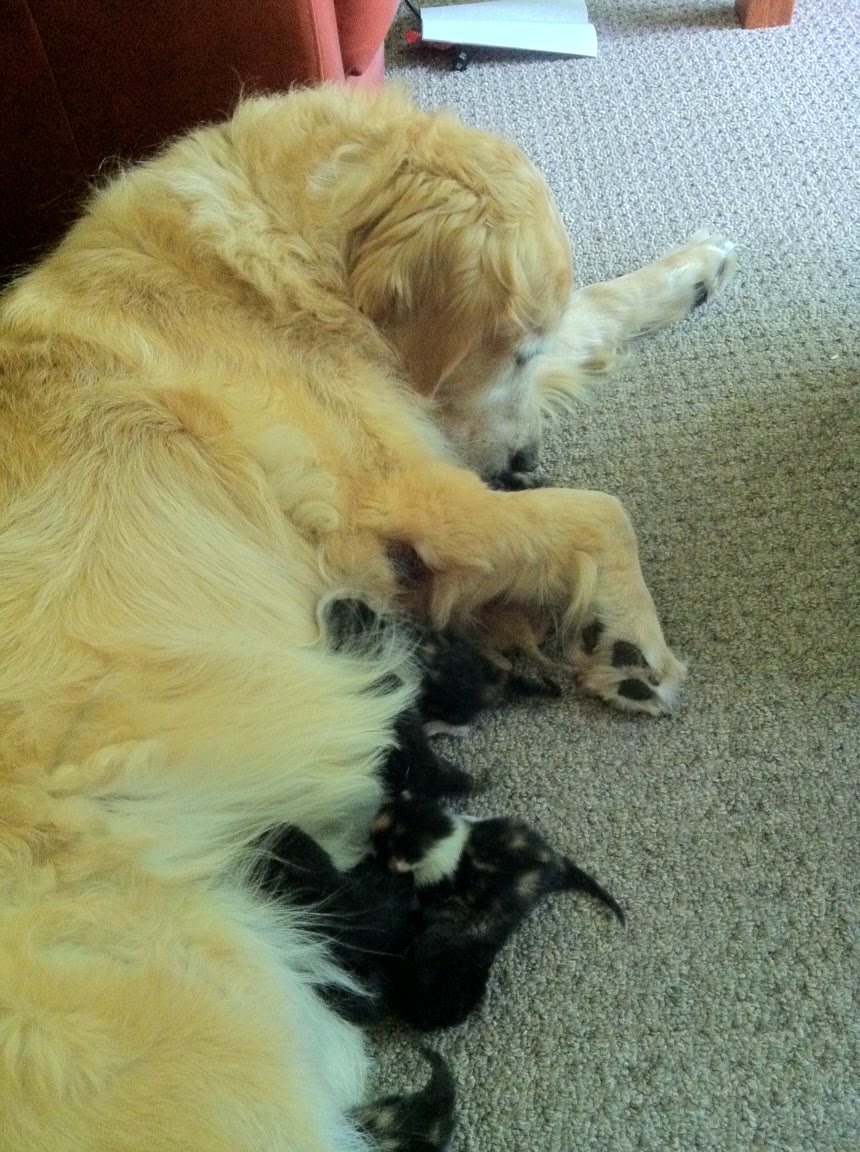
My sister Nance's dog "adopting" a batch of motherless kittens she found in the bush.
Our mother's legacy lives on in all of us, even our dogs!
___________________________________________________________ 


Saturday, May 26, 2012

Under the Dumb Plum Tree

Mud Street
by Jaime Kaufhold
(May 1991)

Finally it is spring. We will still get those colder days, but there is a warm, softness to the air and the sun is definitely getting hotter. The plum tree has already blossomed and soon the flower gardens will be in full bloom.

Spring has a different affect on everyone but for me “spring fever” means it is time to start cleaning. I remember for my children it meant going outside to find some mud. Being a mother, I found that many times our objectives in life clashed. Ironically, we lived on First Road, just off of Mud Street. Yes, that was the name. And during those years of my life I wondered if I’d ever rid myself of the mud.

My children loved the stuff. As soon as they could, they would be fixing up the fort along the treeline (ditch) in a neighbouring field or throwing mud balls at one another. As I watched them trudge off toward their next great adventure, I’d holler, “Stay out of the mud!” By the time lunchtime rolled around they’d be home, totally unaware that they somehow managed to cover their entire bodies in mud. Of course these excursions always meant the dog(s) went along too, adding wet dog smell to the clean up fun.

The kids would go out of their way to stomp in a mud puddle with nice clean shoes or somehow slip into the ditch while waiting for the school bus. Many times I had to hose them off outside. I thought that as they grew older they would lose their fascination with mud but I was wrong. The bigger they got, the more mud they brought home. I think what they enjoyed most was trying to beat the mud. Where we lived it was the consistency of wet cement and pulled like quicksand.

Once Darlene got stuck behind the garage and Nancy got stuck trying to pull her out. I thought they looked pretty funny until I found myself calf deep in the stuff. Karen, who liked mud the least, was able to rescue us by dropping a board down in front, giving us something to crawl onto while we pried our legs out.

And we never forgot the time Mark was late coming home from delivering his newspapers. Sometimes he’d stop and play with friends along the way, so I didn’t start to worry until he didn’t come home for supper. One spring day he’d gotten stuck taking a short cut through a field and it took a few hours before he could unstick himself. I was just getting ready to go look for him when he walked up the driveway, caked mud to his waist, minus his shoes.

Now with the kids grown it appears that I’ve finally beaten the mud. Spring comes so I clean, but there is no one here now to mud things up. Sometimes I watch out the window and see the grandkids working their way past the plum tree towards the garden, pail of water in hand, and I smile. Then I laugh when their mothers try a few hours later to load them in the minivan.

“How did they get mud all over their jeans?” they ask.

So I explain the biology of mud. Not only does it get in their jeans, but its in their genes and from growing up just off Mud Street.
___________________________________________________________